
Akamai acquires Fermyon to combine WebAssembly function-as-a-service (FaaS) with Akamai’s globally distributed platform. Learn more

What Is Defense in Depth?

Defense in depth (DiD) is a cybersecurity strategy that involves deploying multiple defensive layers. DiD employs physical, technical, and administrative controls to create robust barriers against cyberthreats. Incorporating principles like least-privilege access and behavioral monitoring, DiD aims to thwart attackers by increasing the number of obstacles they must overcome.

Defense in depth (DiD) is a cybersecurity strategy that involves deploying multiple types of defensive layers. The underlying theory holds that digital assets will be better protected if a malicious actor has to penetrate more than one barrier to succeed in an attack. This page explores how DiD works.

What does defense in depth mean?

The cybersecurity profession borrowed the concept of DiD from the military, which has historically created multiple physical perimeters around a target. A medieval castle, for example, had a moat, high stone walls, special windows designed for shooting arrows, and walkways atop the walls where defenders could pour boiling water on anyone climbing up the walls. The moat, the walls, the arrows‌ — ‌each was part of a defense-in-depth strategy. On their own, they might not work well, but collectively, they created a strong defensive barrier.

So it is in cybersecurity. An attack target, like a database, has a depth of defenses that include physical barriers against the manipulation of hardware, network access controls, passwords, and threat detection systems. These are the equivalent of a military’s concentric perimeters. These countermeasures create better security than they’d offer on a standalone basis. That’s DiD.

How does defense in depth work?

There’s no single, standardized way to implement DiD. It’s dynamic, changing as newer methods arise and workload requirements change. Different workloads and organizational security priorities will dictate how a security team will set up its DiD architecture. In general, though, DiD usually works through a combination of the following types of controls:

  • Physical — In this era of cloud computing, it’s easy to forget that hardware, including servers, storage arrays, network switches, and the like, is vulnerable to physical interference. With physical access to a server, for example, an attacker could install a rootkit on the spot and hijack the machine. To prevent this from occurring, data centers employ physical controls like biometric scanners, alarms, video surveillance, and so forth.
  • Technical — These include software- and hardware-based controls that mitigate network-borne threats like distributed denial-of-service (DDoS) attacks, malware, phishing, and ransomware. Technologies like firewalls, secure web gateways (SWGs), and extended detection and response (XDR) solutions help provide the technical controls that can mitigate threats coming over the network.
  • Administrative‌ — ‌This is the realm of security policy and user access control. Administrative controls include identity and access management (IAM), user roles, and password policies. If you’re deploying workloads on Akamai Cloud, you are responsible for implementing and managing these controls in line with your security policy.

What are the elements of defense in depth?

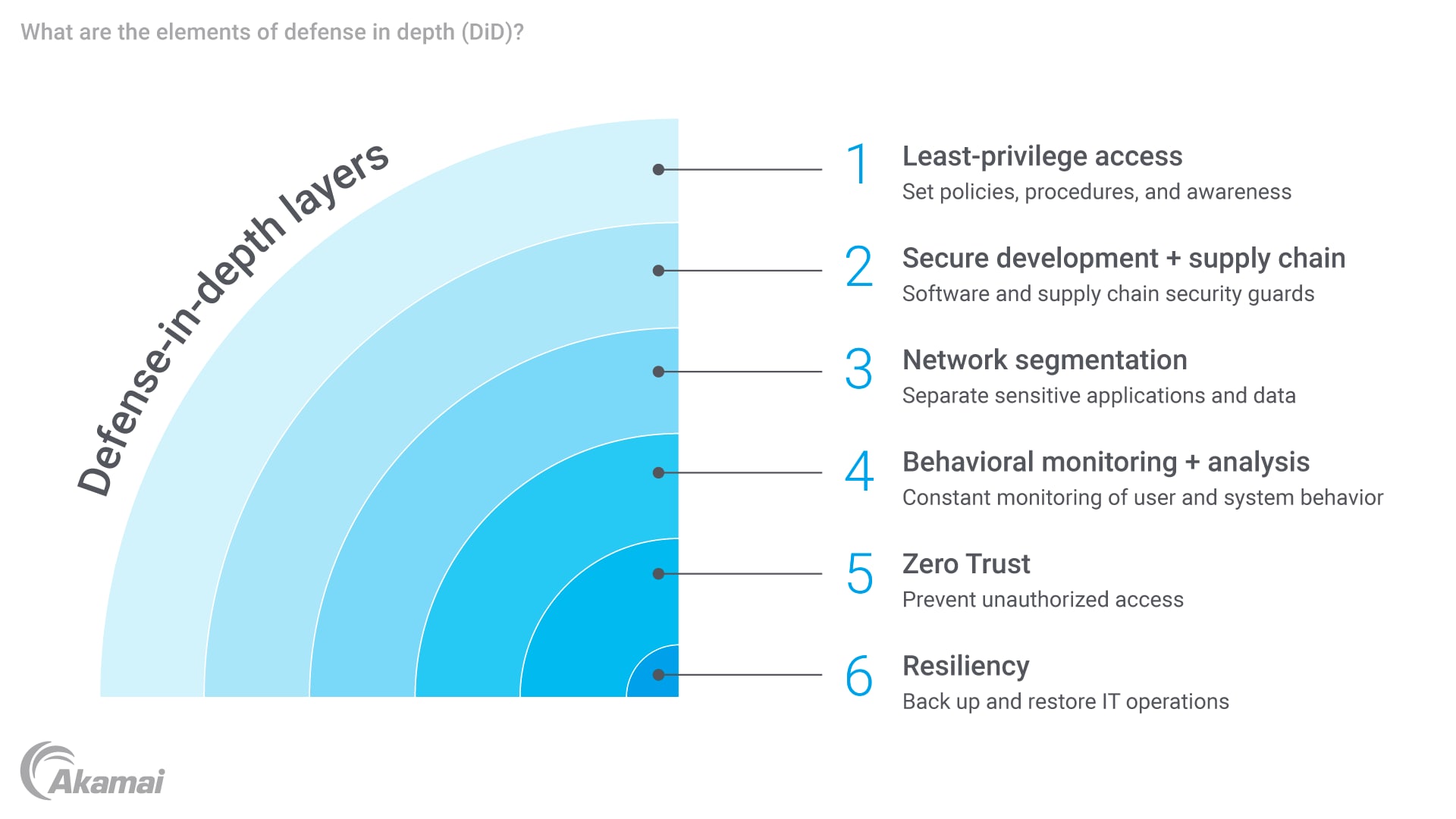
DiD takes shape as security managers apply the controls outlined above, according to the dominant principles of cybersecurity. These are the core elements of DiD:

  • Least-privilege access — Setting a policy that a user should only have the fewest possible privileges is a way to execute a defense-in-depth strategy. This way, if a malicious actor gains access to the network, their ability to breach sensitive data or disrupt operations will be limited.
  • Secure development and supply chain — Software must be subject to security controls as it makes its way from development through testing and into production. This practice ensures that new software won’t introduce vulnerabilities. The software supply chain must also be similarly secured. Blocking an attacker’s path through software adds a tier of defense in a DiD architecture.
  • Network segmentation — Separating sensitive applications and data onto different network segments is an effective way to bar malicious actors from “lateral movement” across a network. This practice acts like the castle walls. If an attacker crosses the moat, they still have to scale the wall.
  • Behavioral monitoring and analysis — Even with multiple tiers of countermeasures, attackers can still get through. Insiders also pose a threat. To mitigate this risk, it is necessary to engage in constant monitoring and analysis of user and system behavior. This process can identify anomalous events that could suggest an attack is underway.
  • Zero Trust — With its foundational rule of “never trust, always verify,” Zero Trust networking prevents much unauthorized access. It adds to the effectiveness of a DiD architecture.
  • Resiliency — The ability to restore IT operations is another tier of DiD. With strong backup and restore functions in place, an organization can recover from even a serious cyber incident, such as a ransomware attack.

What is layered security?

Some people describe DiD as “layered security,” but while each area of DiD protection might be referred to as a layer, the term “layered security” means something different in cybersecurity circles. Layered security refers to deploying multiple security tools to address a single area of security. For example, a firewall and an intrusion prevention system (IPS) both block unwanted access, but they achieve this goal in different ways. Each is a layer of security that works against network penetration.

How does layered security differ from integrated security?

Integrated security is an approach to cybersecurity that relies on connecting multiple security tools to achieve more effective overall threat detection and response. An integrated security model could complement a layered security architecture, connecting different layers into a coherent stack.

For example, firewalls and antivirus software can be integrated with a security incident and event management (SIEM) solution. The SIEM ingests and analyzes data from the firewall and antivirus software to detect threats that neither tool recognized on its own. The SIEM may also be integrated with incident response platforms, such as security orchestration, automation, and response (SOAR) — enabling better responses to attacks that aren’t possible with piecemeal or overly manual processes.

Intrusion detection systems and their role in defense in depth

Intrusion detection systems (IDS) are a crucial element in any defense-in-depth strategy. These systems continuously monitor network traffic and IT systems to detect suspicious activity, unusual behavior, or unauthorized access attempts. By acting as an early warning system, IDS allows security teams to respond to potential breaches before they escalate into full-blown cyberattacks.

IDS can be deployed at various layers of an organization’s network, providing real-time alerts and supporting both passive and active security measures. They enhance network security by identifying patterns of attack, such as malware or phishing attempts, that other tools might miss. Integrating IDS with security information and event management (SIEM) tools allows for a more cohesive and comprehensive approach to detecting and mitigating threats.

Behavioral analysis in cyberattack detection

Behavioral analysis is an advanced method for detecting cyberattacks in a defense-in-depth model. Rather than relying solely on predefined threat signatures, behavioral analysis monitors user and system activities for deviations from the norm. By understanding what constitutes “normal” behavior in a network or system, security solutions can flag abnormal patterns that may indicate a security breach or attempted intrusion.

This approach is particularly effective in detecting zero-day vulnerabilities and insider threats, in which attackers may try to avoid traditional security measures by mimicking legitimate user behavior. Behavioral analysis tools, often integrated with endpoint security solutions like endpoint detection and response (EDR), provide enhanced visibility into network activity and user behavior, enabling faster detection and response to threats.

Conclusion

DiD, layered security, and integrated security shouldn’t be isolated security strategies. Rather, it’s optimal if they are designed to work together. DiD may comprise a layered security architecture, with different layers integrated for more powerful security capabilities overall. The underlying principles remain the same, no matter how the security architecture is set up: The more countermeasures standing between the target and the attacker, the more likely it will be that the attacker fails. That’s the enduring objective of defense in depth.

Frequently Asked Questions

Defense in depth (DiD) provides several advantages for businesses. It enhances resilience by diversifying security measures, ensuring that if one layer is breached, others remain intact. Additionally, DiD improves detection capabilities by increasing visibility across the environment, enabling timely identification of suspicious activities.

Defense in depth aligns with regulatory and compliance requirements, such as GDPR and PCI DSS, by implementing robust security controls. Adhering to these standards mitigates legal and financial risks and fosters trust among customers and stakeholders. Overall, defense in depth offers a comprehensive and effective approach to security.


To implement a defense-in-depth strategy in your organization, you must follow a structured approach that encompasses several key steps:

  1. Assess risks: Begin by conducting a thorough risk assessment to identify potential security threats and vulnerabilities to your organization, including data breaches, API security threats, malware infections, or insider threats.

  2. Develop a security policy: Develop a security policy that outlines the organization’s security objectives, standards, and procedures.

  3. Implement security controls: Deploy a range of security controls across multiple layers of your organization’s IT infrastructure.

  4. Regularly update and test: Regularly update and patch software, firmware, and security systems to address known vulnerabilities and protect against emerging threats.

  5. Educate employees: Provide comprehensive security awareness training about common security risks, best practices, and procedures.

  6. Monitor and adapt: Implement continuous monitoring tools and processes to monitor network traffic, system logs, and user activities for signs of suspicious behavior or security incidents.

DiD is a cybersecurity strategy that involves deploying several layers of defense mechanisms to protect against various threats and vulnerabilities. However, defense in depth is often complemented by other cybersecurity strategies. One such strategy is Zero Trust, which focuses on verifying every user and device that attempts to access resources, regardless of their location or network perimeter.

Defense-in-depth measures should be reviewed and updated regularly to adapt to evolving threats and changes in the organization’s environment. As cybersecurity threats evolve, organizations must stay proactive in maintaining their defenses. Regular security testing, assessments, and audits ensure that security controls remain effective and aligned with the organization’s risk profile.

Defense in depth improves network security by layering multiple protective measures throughout the IT infrastructure. These layers include network segmentation, firewalls, intrusion detection systems, and endpoint detection and response (EDR). The overlapping defenses work together to create a robust security posture, ensuring that even if one layer is compromised, others remain in place to protect against cyberattacks.

Multi-factor authentication (MFA) strengthens security by requiring users to verify their identity through multiple forms of credentials, such as passwords and biometrics. MFA adds an extra layer of protection, ensuring that even if a password is stolen, an attacker cannot access sensitive systems without the second factor. This method complements other defense mechanisms by limiting unauthorized access.

Defense in depth addresses multiple attack vectors by deploying different types of security solutions across the network. By layering various defenses such as firewalls, antivirus software, and behavioral analysis tools, organizations can detect and block attacks from different entry points, including email phishing, malware, and brute-force login attempts.

Maintaining a defense-in-depth strategy can be challenging due to the complexity of managing multiple security layers. It requires continuous monitoring, regular updates, and audits to ensure that all defenses remain effective. Additionally, the cost of deploying multiple security tools and the potential for redundancy can pose challenges for smaller organizations. However, these efforts are critical for ensuring comprehensive protection against evolving cyberthreats.

Redundancy is important for defense in depth, because it ensures that if one security control fails or is compromised, other measures continue to protect the system. By deploying overlapping security solutions, organizations reduce the risk of a single point of failure and strengthen their overall resilience against cyberattacks.

Why customers choose Akamai

Akamai is the cybersecurity and cloud computing company that powers and protects business online. Our market-leading security solutions, superior threat intelligence, and global operations team provide defense in depth to safeguard enterprise data and applications everywhere. Akamai’s full-stack cloud computing solutions deliver performance and affordability on the world’s most distributed platform. Global enterprises trust Akamai to provide the industry-leading reliability, scale, and expertise they need to grow their business with confidence.

Related Blog Posts

AI Pulse: How AI Bots and Agents Will Shape 2026
Read our reflections on AI bot traffic across the Akamai network in 2025 and get our predictions for how these trends will shape agentic commerce in 2026.
Peak Season Isn’t a Season. It’s the World You Operate In.
Peak season isn’t seasonal anymore. Learn why modern surges stem from security risks, not traffic, and how Akamai keeps businesses resilient every day.
AI Pulse: How AI Bots Surface Your Content
Read about the different ways AI systems gather content — and learn why evasive scrapers, not just AI bots, continue to exert most of the pressure on media.

Related Customer Stories

Explore all Akamai Security Solutions

Start your free trial and see what a difference having the world’s largest and most trusted cloud delivery platform can make.