
Akamai acquires Fermyon to combine WebAssembly function-as-a-service (FaaS) with Akamai’s globally distributed platform. Learn more

What Is Static Application Security Testing (SAST)?

Static application security testing (SAST) is a vital tool for analyzing application security code for security vulnerabilities before it’s compiled. SAST takes place very early in the software development lifecycle, which enables early detection and resolution of issues, enhancing overall software security.

Static application security testing (SAST), sometimes called source code analysis or static analysis, is a white-box methodology and workflow for testing. According to Gartner, the term SAST represents a set of technologies created to help developers analyze binaries, bytecode, and application source code to detect coding and design conditions that flag security flaws.

SAST is a commonly used application security (AppSec) tool that identifies and helps remediate ‌the root cause of security vulnerabilities. SAST tools don’t need a system to be running to perform a scan, because they analyze web applications from the inside out. For example, SAST testing may be used for regulatory compliance with the Payment Card Industry Data Security Standard (PCI DSS), or to improve insight into software risk.

Why SAST is important

The reality is that there are far more developers than security staff. SAST tools can analyze 100% of the codebase much more rapidly than human secure code reviews. It takes only minutes for these SAST tools to scan millions of lines of code to identify critical vulnerabilities. Ultimately, these tools help organizations achieve key goals, such as:

Shift-left security testing: Integrating SAST into the earliest stages of software development helps shift security testing left. Detecting proprietary code vulnerabilities and other security issues during the design stage while they’re easier to resolve is an important practice.

Secure coding: SAST readily identifies basic coding errors so development teams can easily follow the best practices for secure coding standards.

Simplifying use: Integrating SAST earlier in the existing CI/CD pipeline and DevOps environment saves developers from needing to trigger or separately configure scans. This makes it more efficient, convenient, and easier for them to use, and eliminates the need for developers to leave their environment to conduct scans, see results, and remediate security issues.

How does SAST work?

Because it can take place without code being executed and doesn’t require a working application, SAST takes place very early in the software development lifecycle (SDLC). This helps developers quickly resolve issues and identify vulnerabilities in the project’s initial stages without passing on vulnerabilities to the final application.

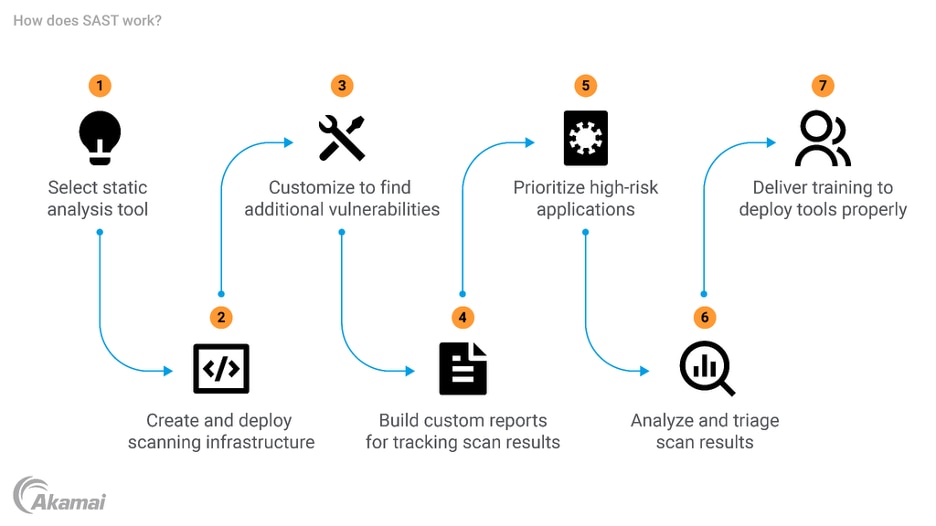
SAST testing typically happens in the following steps:

  1. Select a static analysis tool that can comprehend the underlying software framework and perform code reviews of applications written in the right programming languages.
  2. Create the scanning infrastructure and take steps to deploy the tool. This includes setting up access control and authorization, handling the licensing requirements, and procuring required resources such as databases and servers for deployment.
  3. Customize the tool and configure it to find additional security vulnerabilities or reduce false positives by updating existing rules or writing new ones.
  4. Build custom reports and create dashboards for tracking scan results as you integrate the tool into the build environment.
  5. Prioritize high-risk applications and onboard all applications.
  6. Analyze and triage scan results to remove false positives, track results, and deploy results to the proper teams for timely remediation.
  7. Deliver robust training and the proper governance to ensure development teams employ SAST tools properly. Include SAST and software security touchpoints within the SDLC, and as part of your application development process and into deployment.

Static vs. dynamic application security testing (SAST vs. DAST)

There are important differences between SAST and DAST.

Static application security testing (SAST) comes early in the CI pipeline and focuses on bytecode, source code, or binary code to identify coding patterns that are problematic or conflict with best practices. Although modern SAST supports multiple programming languages, the methodology is programming-language dependent.

Dynamic application security testing (DAST) is an approach to black-box testing. Because it requires runtime to scan applications, it is applied later in the CI/CD pipeline. DAST doesn’t depend on a specific programming language, so it is a good method for preventing regressions.

Consider the major differences in DAST vs. SAST:

  • ​​SAST scans source code lines for vulnerabilities. In contrast, DAST works solely on the inputs and outputs from a running application and lacks any information about its code.
  • Another major difference is speed, in that especially for complex running applications, a DAST tool requires more time to execute, compared to how long the SAST tool takes to scan the source code.

In practice, given the difference between SAST and DAST tools, best practices suggest using both. A SAST tool and DAST tool complement each other, and each finds vulnerabilities the other does not.

Static vs. interactive application security testing (SAST vs. IAST)

Like DAST, interactive application security testing (IAST) focuses on application behavior during runtime. However, IAST analysis takes more of a hybrid approach, combining analysis of internal application flows with scanning and black-box testing. IAST is most beneficial in its ability to connect source code with DAST-like findings. But this also makes IAST both programming-language dependent (as it needs to scan source code) and restricted to being performed later in the CI/CD pipeline.

What is the difference between SAST and SCA?

The SAST vs. SCA comparison is somewhat of an apples-to-oranges analogy. Software composition analysis (SCA) focuses on the application’s third-party code dependencies. SCA tools discover all software components, including all direct and indirect dependencies and supporting libraries. SCA is very useful for applications that use many open-source libraries.

How to implement SAST

In general, there are several steps to implement SAST:

  • Select the cloud or on-premises for the means of deployment. The decision depends on how much control is needed, how much scalability, cost, and other factors.
  • Configure and integrate SAST into the SDLC. It’s possible to analyze the source code as it’s compiled, scan it as it is merged into the codebase, run SAST in IDE, or simply add SAST in your CI/CD pipeline.
  • Choose the extent of the SAST analysis. A complete SAST analysis is the most comprehensive and lengthy, and consists of a full scan of all applications and their code. An incremental scan analyzes only changed code. A desktop configuration scans code in real time as it’s written.

Customize the process to identify new security flaws or reduce false positives by revising old rules or creating new ones. Prioritize results based on factors such as severity of threat, compliance issues, CWE, responsibility, risk level, or vulnerability.

Improving code quality with SAST: A DevSecOps approach

Incorporating DevSecOps principles into the software development lifecycle enhances both cybersecurity and code quality. Static application security testing (SAST) is a key component of this approach, enabling continuous integration by detecting vulnerabilities early and ensuring secure, efficient coding practices.

Benefits of SAST in DevSecOps

  • Enhanced security posture: SAST helps identify and address security risks such as SQL injection, XSS, and buffer overflows during the development phase, aligning with OWASP Top 10 recommendations.
  • Improved developer workflow: By embedding SAST into continuous integration pipelines, developers can receive immediate feedback on potential issues, reducing the cost and complexity of remediating vulnerabilities.
  • Proactive risk mitigation: Regular SAST scans minimize risks associated with insecure Java and JavaScript code, improving the reliability of APIs and other application components.

SAST in the CI/CD pipeline

Integrating SAST into CI/CD pipelines ensures that every code change undergoes rigorous testing. This allows data scientists, security engineers, and developers to collaborate on addressing security risks without disrupting the workflow. Combining SAST with tools like static code analysis platforms streamlines vulnerability detection and resolution.

Frequently Asked Questions

Before we get into when SAST should be performed, let’s first answer the question: What is SAST?


SAST, or static application security testing, is an important process that takes place in the early stages of the software development process, usually around the same time the code for the software program is written. It’s easily woven into the development process and the CI/CD pipeline.


An API security checklist should be used during SAST to ensure every step of the process is completed and verified. Following API security best practices also ensures all issues are efficiently tracked and reported. When issues are found, teams should work together to quickly address them so processes are performed on time and as securely as possible.


API vulnerabilities include buffer overflows, XSS (cross-site scripting), IDOR (insecure direct object references), and SQL injection. These are just a few disruptions that can dramatically affect the stability of your security protocols. Any undetected vulnerability can cause significant damage to your programs and jeopardize the safety of your confidential information.


Solid SAST protocols ensure your programs run smoothly and that the highest level of security is always maintained. Finding vulnerable areas and making adjustments as soon as they are discovered will ensure all your systems are secure.

SAST can be used on various applications where the source code is accessible. This includes desktop applications, mobile apps, and many other web applications. Any security platform, especially those that use SAST, will vary in effectiveness depending on the programming language used during its creation.

SAST/DAST and API security testing are highly effective, but there are some limitations. While SAST can’t analyze a running application for potential abnormalities, dynamic application security testing (DAST) can. SAST also has difficulty identifying any malfunctions that only occur when the program is operational.
 

Authentication problems and server configuration errors are two of the most common limitations of SAST. However, it’s crucial to understand the difference between SAST and DAST to ensure you choose the correct security testing for your application.

Why customers choose Akamai

Akamai is the cybersecurity and cloud computing company that powers and protects business online. Our market-leading security solutions, superior threat intelligence, and global operations team provide defense in depth to safeguard enterprise data and applications everywhere. Akamai’s full-stack cloud computing solutions deliver performance and affordability on the world’s most distributed platform. Global enterprises trust Akamai to provide the industry-leading reliability, scale, and expertise they need to grow their business with confidence.

Related Blog Posts

AI Pulse: How AI Bots and Agents Will Shape 2026
Read our reflections on AI bot traffic across the Akamai network in 2025 and get our predictions for how these trends will shape agentic commerce in 2026.
Peak Season Isn’t a Season. It’s the World You Operate In.
Peak season isn’t seasonal anymore. Learn why modern surges stem from security risks, not traffic, and how Akamai keeps businesses resilient every day.
AI Pulse: How AI Bots Surface Your Content
Read about the different ways AI systems gather content — and learn why evasive scrapers, not just AI bots, continue to exert most of the pressure on media.

Related Customer Stories

Explore all Akamai Security Solutions

Start your free trial and see what a difference having the world’s largest and most trusted cloud delivery platform can make.