
Akamai acquires Fermyon to combine WebAssembly function-as-a-service (FaaS) with Akamai’s globally distributed platform. Learn more

What Is Dynamic Application Security Testing (DAST)?

What Is Dynamic Application Security Testing (DAST)? 

Dynamic application security testing (DAST) is an automated security testing technique that is used to identify vulnerabilities in web applications. The best DAST tools simulate various types of attacks to detect security vulnerabilities and test a broad spectrum of endpoints, including hidden values. By simulating malicious attacks on an application, automated DAST security tools can help identify outcomes that are far outside the typical user experience.

DAST is an advanced testing method for an application in an operating state. The process focuses on testing the production environment and analyzing application security at runtime. It tests how systems and components interact in practice and identifies real-world vulnerabilities without much need for insight into the provenance of any single component.

DAST testing is operational and behavioral in that testers identify problems that occur during use and then trace them back to their origins in the software design, rather than detecting issues linked to a code module. It’s useful for basic security on evolving projects and for achieving industry-standard compliance.

How does DAST work?

Although many see dynamic application security testing as an always-automated approach, DAST is widely divided into two types: manual DAST and automated DAST.

Manual DAST simply refers to using knowledge of a specific field and experience to detect vulnerabilities DAST scanners might miss. Automated dynamic application security testing includes feeding data to dynamic application security testing protection software to test applications. This type of automated test includes scanners, fuzzers, crawlers, and other tools that can identify vulnerabilities such as cross-site scripting (XSS), SQL injection, and server-side request forgery. For example, a DAST attack can send a large string of numbers to help identify a SQL injection flaw.

Dynamic application security testing products function without getting into the source code, so they demand no prior knowledge of a programming language. This makes dynamic application security testing software easy to use. And because DAST detects vulnerabilities in the source code at runtime, there is no need to rebuild an application to test it for vulnerabilities.

Advantages of dynamic application security testing

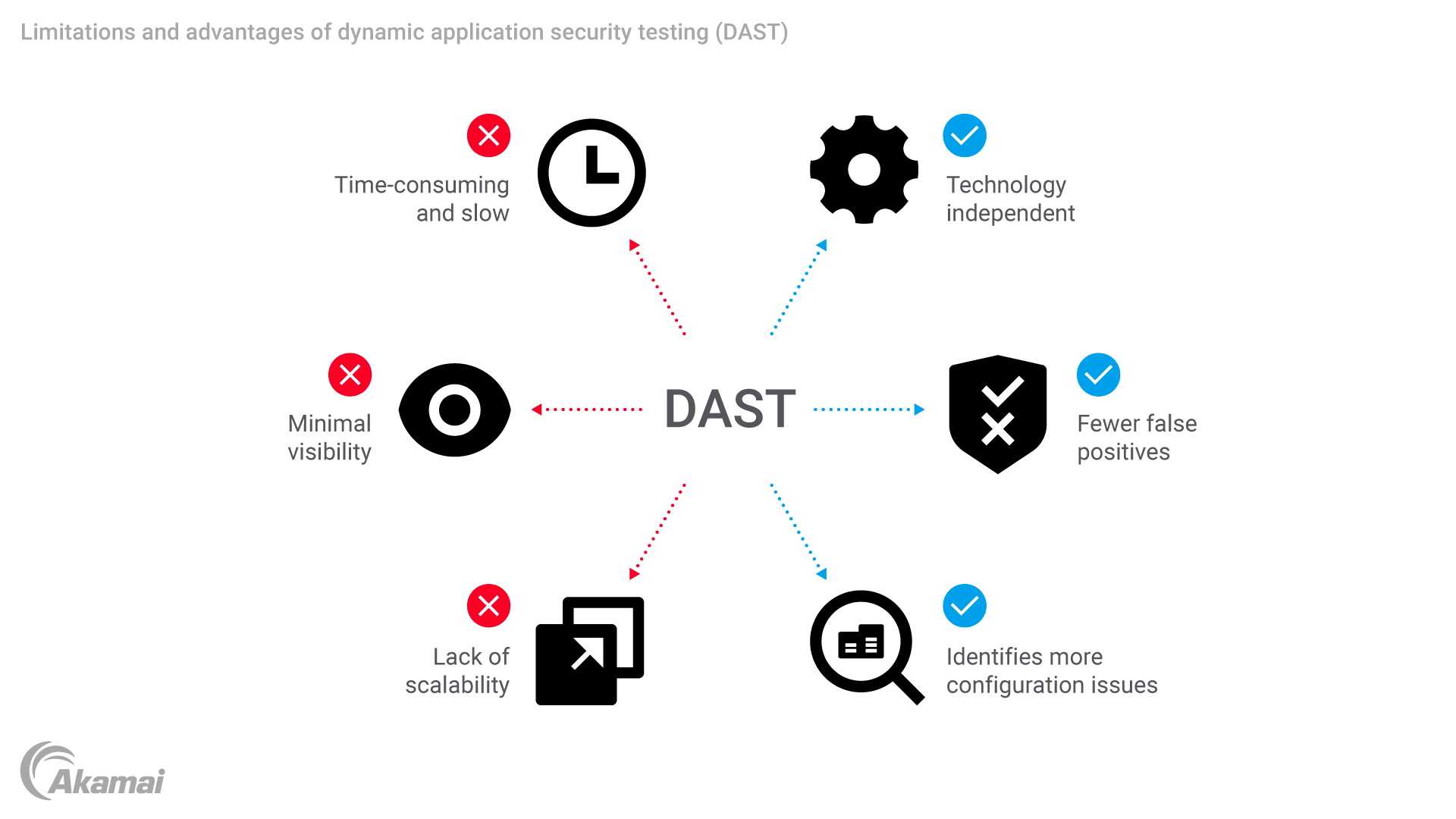
DAST benefits application security as a whole in many ways. One of the primary benefits is that a DAST security tester attempts to hack an application when it’s running as an attacker would. Some additional benefits include:

  • Technology independent: Because it doesn’t rely upon source code, DAST is language and platform-agnostic. Not being limited by particular technologies and languages allows users to run a single DAST tool on all applications.
  • Fewer false positives: According to OWASP’s Benchmark Project, there is a lower false positive rate from DAST and less noise than with other application security testing tools.
  • Identifies more configuration issues: Because DAST focuses on detecting operational security vulnerabilities and attacks on applications from the outside in, it is well suited to identifying configuration mistakes other AST tools miss.

Though there are myriad benefits to using DAST, there are also a number of limitations that would encourage developers to seek other means of testing:

  • Lack of scalability: DAST relies heavily on effective tests, and security experts are needed to write them. This makes scaling DAST very difficult, as there are often a limited number of expert resources available.
  • Minimal visibility: DAST lacks visibility into the application’s codebase, so DAST alone can’t offer comprehensive security coverage or insight into problematic code for purposes of remediation.
  • Time-consuming: DAST can be slow; according to Forrester, DAST scans can last as long as five to seven days. DAST scans often do not detect vulnerabilities until they are more costly and time-consuming to fix, later in the software development lifecycle (SDLC).

DAST vs. other application security testing

Regarding SAST vs. DAST vs. IAST, each kind of application security tool takes a different approach to web application security. There are several categories to understand:

Static application security testing (SAST)

Static application security testing is a methodology for white-box testing in which source code is analyzed from the inside outward while components are at rest.

Interactive application security testing (IAST)

Interactive application security testing is a kind of hybrid, grey-box strategy that works through instrumentation of the code from within an application while it is running to detect and report issues.

Software composition analysis (SCA)

Software composition analysis offers visibility into open source software components by scanning the codebase for application vulnerabilities, including license compliance issues.

Static vs. dynamic application security testing

The difference between static and dynamic application security testing is that DAST takes an “outside in” approach, attacking the application like a malicious actor would. A DAST scanner performs these attacks and identifies security vulnerabilities from results that are unexpected within the result set.

Conversely, SAST analyzes the source code of an application, a static environment, using an “inside out,” approach, searching for vulnerabilities. SAST scanners must support both the language and the web application framework in use. In contrast, DAST scanners rely on HTTP and interact with an application from the outside.

It is a best practice to use both SAST and DAST to optimally strengthen security posture. To address this DAST vs. SAST issue, the interactive application security testing (IAST) grey-box methodology was developed, combining the benefits of both methodologies.

Dynamic application security testing vs. penetration testing

Although they seem similar, there is a difference between dynamic application security testing and penetration testing. DAST testing systematically focuses on the running state of the application, while penetration testing (with owner permission) uses common hacking techniques to exploit vulnerabilities in the application and beyond it, including ports, firewalls, servers, and routers.

During penetration testing (or pen testing), a cybersecurity expert launches simulated attacks to find computer system vulnerabilities and identify weak spots that attackers could exploit. Modern pen testing blends technology and automation with the human expertise of manual testers.

Integrating DAST into a DevOps environment

Integrating dynamic application security testing (DAST) into a DevOps environment requires a coordinated approach to ensure that security is embedded throughout the software development lifecycle (SDLC). By automating DAST scans within the continuous integration/continuous delivery (CI/CD) pipeline, development teams can detect security vulnerabilities early, before they reach production. This process not only reduces potential risks but also improves overall application security.

To successfully integrate DAST into a DevOps workflow, organizations should establish clear collaboration between security and development teams, adopting a DevSecOps mindset. Automated DAST tools should be configured to run during each build, ensuring real-time testing for vulnerabilities in the running application.

Black-box testing: Uncovering real-world vulnerabilities

As a black-box testing method, DAST focuses on analyzing the application from an external perspective, treating the application as a “black box” without visibility into its source code. This allows DAST to mimic the actions of a malicious actor who has no knowledge of the internal workings of the application, helping identify potential attack vectors such as injection flaws, authentication bypasses, and XSS.

Black-box testing is particularly useful for detecting runtime vulnerabilities that static testing methods may miss. Since DAST works on the running application, it reveals security flaws within the context of real-world usage, making it a powerful tool for safeguarding against external threats.

How DAST complements a DevSecOps strategy

In a DevSecOps environment, DAST plays a crucial role in enhancing the overall security posture of applications by seamlessly integrating security testing into the development and operations processes. DAST scans can be automated within the CI/CD pipeline to provide continuous feedback on the security status of the application as new code is deployed.

By combining DAST with static analysis tools (SAST) and other security measures, organizations create a more comprehensive security framework that addresses both static and runtime vulnerabilities. This approach ensures that security is treated as a shared responsibility across the development, operations, and security teams, ultimately reducing the time it takes to detect and remediate security risks.

Frequently Asked Questions

Dynamic application security testing (DAST) is essential for web application security due to its unique capabilities. DAST helps identify runtime vulnerabilities by simulating real-world hacking attempts. By actively scanning applications during runtime, DAST tools uncover vulnerabilities that may evade traditional static analysis.

This approach provides a comprehensive understanding of the application’s security position, enabling organizations to address vulnerabilities before malicious actors can exploit them. Incorporating DAST into security testing strategies enhances cybersecurity by fortifying web applications against cyberattacks and ensuring robust protection for sensitive data and assets.


The frequency of dynamic application security testing assessments depends on various factors. For critical applications or those handling sensitive data, monthly or weekly scans may be necessary. Applications undergoing frequent updates or modifications to the codebase or environment should also undergo more frequent DAST scans to detect new vulnerabilities. 

On the other hand, less complex applications with stable codebases may require less frequent assessments, such as quarterly or semiannually. Incorporating DAST into regular security testing schedules ensures ongoing protection for web applications, complementing other security measures like API security and maintaining robust defenses against evolving threats.

Implementing dynamic application security testing can pose several challenges. Managing false positives, where the tool incorrectly identifies benign code as vulnerabilities, can consume valuable resources and time. Integrating DAST into existing development workflows seamlessly without disrupting the development process can also be challenging.

Ensuring adequate coverage across various application components and environments requires careful planning and coordination. Overcoming these challenges involves selecting appropriate DAST tools, establishing clear processes for addressing false positives, and integrating testing seamlessly into the development lifecycle. Despite these hurdles, the benefits of DAST in enhancing web application security justify the effort invested in its implementation.

When deciding on a dynamic application security testing tool, consider several key factors. First, ensure compatibility with your technology stack and your web applications. Look for user-friendly tools that offer seamless integration capabilities into your existing development workflows. Scalability is essential, as the tool should accommodate the growth of your applications.

Why customers choose Akamai

Akamai is the cybersecurity and cloud computing company that powers and protects business online. Our market-leading security solutions, superior threat intelligence, and global operations team provide defense in depth to safeguard enterprise data and applications everywhere. Akamai’s full-stack cloud computing solutions deliver performance and affordability on the world’s most distributed platform. Global enterprises trust Akamai to provide the industry-leading reliability, scale, and expertise they need to grow their business with confidence.

Related Blog Posts

AI Pulse: How AI Bots and Agents Will Shape 2026
Read our reflections on AI bot traffic across the Akamai network in 2025 and get our predictions for how these trends will shape agentic commerce in 2026.
Peak Season Isn’t a Season. It’s the World You Operate In.
Peak season isn’t seasonal anymore. Learn why modern surges stem from security risks, not traffic, and how Akamai keeps businesses resilient every day.
AI Pulse: How AI Bots Surface Your Content
Read about the different ways AI systems gather content — and learn why evasive scrapers, not just AI bots, continue to exert most of the pressure on media.

Related Customer Stories

Explore all Akamai Security Solutions

Start your free trial and see what a difference having the world’s largest and most trusted cloud delivery platform can make.