
An AI agent is an autonomous entity that perceives its environment through sensors, processes that information, makes decisions based on its goals, and acts upon the environment using effectors. It is characterized by its ability to operate independently and often learn and adapt over time.
What Is Agentic Artificial Intelligence (AI)?
Agentic artificial intelligence (AI) refers to AI systems designed to operate as autonomous agents. These systems are characterized by their ability to perceive their environment, reason about their perceptions, make decisions, and execute actions to achieve predefined goals. Unlike traditional AI systems that typically perform specific, preprogrammed tasks, agentic AI systems exhibit a higher degree of independence and adaptability, often operating in dynamic and unpredictable environments without constant human intervention.
Key characteristics of agentic AI
Agentic AI systems possess several defining characteristics that enable their autonomous and adaptive behavior.
Autonomy: Autonomy is a fundamental characteristic, indicating an agent’s ability to operate independently without direct human control for extended periods. This involves initiating actions, managing resources, and making decisions based on internal states and environmental feedback.
Goal-oriented behavior: Agentic AI systems are programmed with specific objectives or goals they strive to achieve. Their actions and decisions are consistently directed toward fulfilling these goals, often involving complex sequences of operations and strategic planning.
Environmental interaction: These agents are designed to perceive and interact with their surrounding environment. This interaction can involve sensing physical conditions, receiving digital inputs, or communicating with other agents and systems. The ability to interpret environmental cues is crucial for informed decision-making.
Learning and adaptation: Agentic AI often incorporates mechanisms for learning and adaptation. This means the system can modify its behavior and improve its performance over time based on experiences, feedback, and new information acquired from its environment. This capability allows for robustness in changing conditions.
Decision-making: Central to agentic AI is its capacity for complex decision-making. Agents analyze available information, evaluate potential outcomes of various actions, and select the most appropriate course of action to progress toward their goals. This process often involves sophisticated algorithms for planning and problem-solving.
How traditional AI differs from agentic AI
The distinction between traditional AI and agentic AI lies primarily in their operational paradigms and capabilities.
Traditional AI: Traditional AI typically refers to systems that execute preprogrammed rules or algorithms to perform specific tasks. These systems are often reactive, responding to inputs in a predictable manner based on their design. They generally lack the ability to set their own goals, learn from diverse interactions, or operate autonomously in complex and unforeseen circumstances. Examples include expert systems, rule-based systems, and early machine learning models that require significant human oversight for task definition and execution.
Agentic AI: In contrast, agentic AI systems are proactive and autonomous. They can perceive their environment, reasoning about information, making independent decisions, and taking actions to achieve specified goals. These systems can adapt their behavior, learn from experience, and often operate with minimal human intervention in dynamic environments. The emphasis is on continuous operation toward a goal rather than discrete task execution.
Components of an agentic AI system
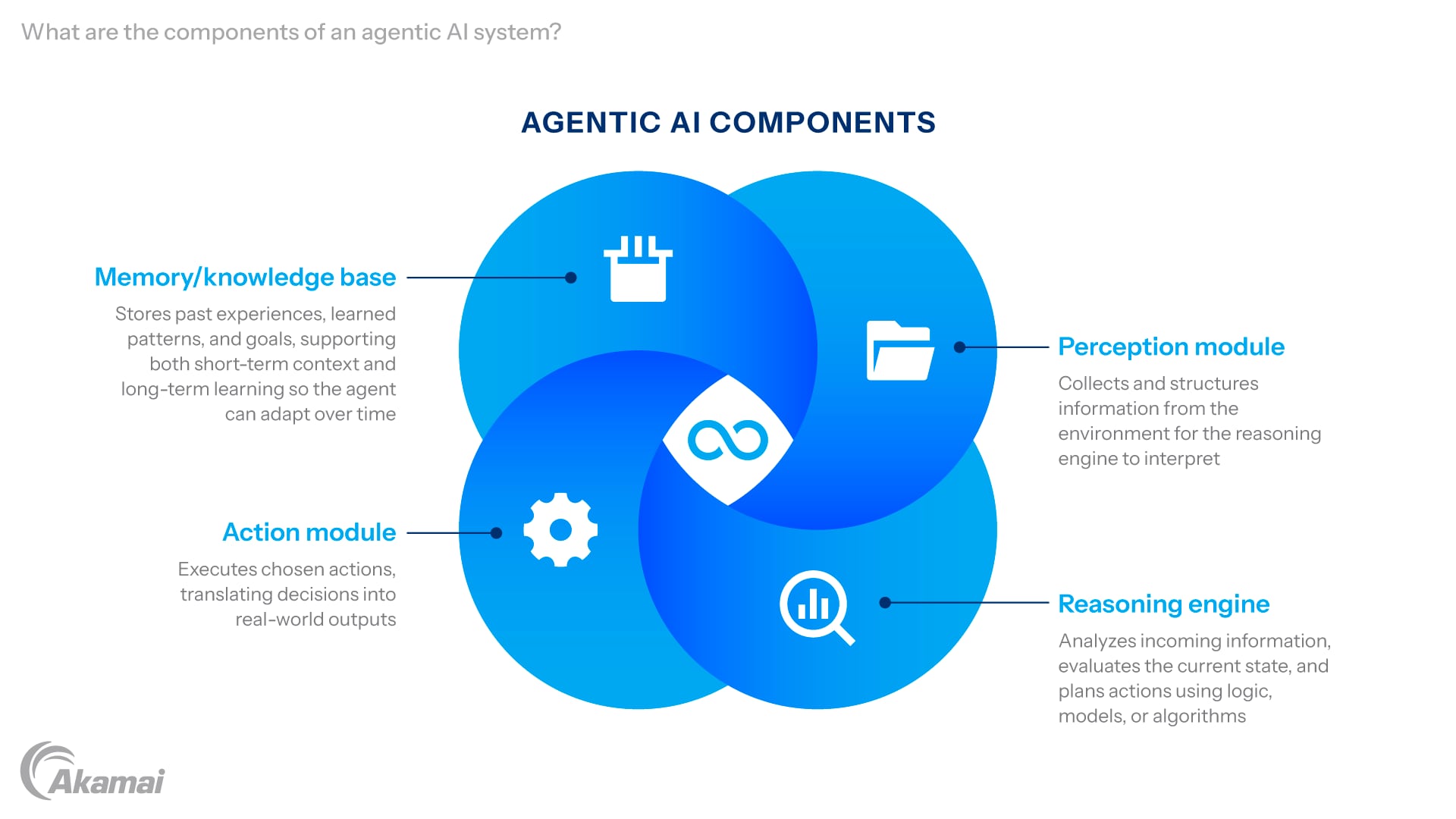
An agentic AI system is typically composed of several integrated modules that facilitate its autonomous operation.
Perception module: The perception module is responsible for gathering information from the agent’s environment. This can involve sensors collecting data (e.g., cameras, microphones, accelerometers in robotics) or software interfaces receiving digital inputs (e.g., data streams, user queries). It processes raw data into a structured format that the reasoning engine can interpret.
Reasoning engine: The reasoning engine is the core intelligence of the agent. It processes perceived information, analyzes current states, and plans future actions. This module often utilizes algorithms for logical inference, decision trees, neural networks, or planning algorithms to determine the most effective strategy to achieve the agent’s goals.
Action module: The action module translates the decisions made by the reasoning engine into executable commands or behaviors. In a robotic system, this could involve controlling motors to move an arm; in a software agent, it might involve sending a message, updating a database, or performing a calculation.
Memory/knowledge base: The memory or knowledge base stores information crucial for the agent’s operation. This includes experiences, learned patterns, environmental models, and predefined goals. It serves as a repository for both short-term working memory and long-term learned knowledge, enabling the agent to learn and adapt over time.
Applications of agentic AI
Agentic AI has a wide range of applications across various industries due to its capabilities in autonomy and adaptive decision-making.
Robotics and autonomous systems: In robotics, agentic AI enables robots to navigate complex environments, perform tasks such as manufacturing, exploration, or delivery without continuous human control. Autonomous vehicles are a prime example, where agents perceive road conditions, make driving decisions, and adapt to traffic changes.
Personal assistants: AI-powered personal assistants (e.g., virtual assistants on smartphones) utilize agentic principles to understand user commands, access information, schedule appointments, and control smart home devices, often learning user preferences over time.
Financial trading: Agentic AI systems are employed in algorithmic trading to analyze market data, predict trends, and execute trades automatically. These agents can respond to market fluctuations in real time, optimizing investment strategies.
Healthcare diagnostics: In healthcare, agentic AI can assist in diagnostics by analyzing patient data, medical images, and symptoms to identify potential conditions. These systems can learn from vast datasets to improve accuracy over time, aiding clinicians in decision-making.
Smart cities: Agentic AI plays a role in smart city initiatives by managing traffic flows, optimizing energy consumption in buildings, monitoring public safety, and managing waste collection. Agents can coordinate various urban systems to improve efficiency and quality of life.
Challenges and ethical considerations in agentic AI
The development and deployment of agentic AI systems also present significant challenges and ethical considerations that require careful attention.
Safety and control: Ensuring that agentic AI systems operate safely and remain under human control is paramount. Malfunctions or unintended behaviors could have serious consequences, particularly in critical applications like autonomous vehicles or medical devices. Establishing clear boundaries and fail-safes is essential.
Transparency and explainability: The complex decision-making processes of agentic AI can often be opaque, making it difficult to understand why a particular decision was made. This lack of transparency, known as the “black box problem,” challenges accountability and trust, especially in sensitive domains. Developing explainable AI (XAI) is crucial.
Bias and fairness: Agentic AI systems learn from data, and if this data contains biases (e.g., demographic or historical biases), the AI can perpetuate or amplify these biases in its decisions. This can lead to unfair or discriminatory outcomes, highlighting the need for careful data curation and bias detection/mitigation strategies.
Accountability: Determining who is responsible when an autonomous agent makes an error or causes harm is a complex legal and ethical question. Assigning accountability among developers, operators, and the AI itself requires new legal frameworks and ethical guidelines.
What is the future of agentic AI?
The future of agentic AI is characterized by continuous advancement and integration into increasingly complex systems. Research is focused on enhancing agents’ learning capabilities, improving their ability to handle uncertainty, and developing more robust methods for human–AI collaboration. This includes progress in areas such as multi-agent systems, where multiple agents cooperate to achieve common goals, and in developing more sophisticated reasoning and emotional intelligence for agents. As these technologies mature, agentic AI is expected to become an even more pervasive and transformative force across industries, fundamentally altering how tasks are performed and how humans interact with technology.
Frequently Asked Questions
Agentic AI works by continuously performing a perception–reasoning–action cycle. It perceives information from its environment, processes this information through a reasoning engine to understand the situation and make decisions, and then execute actions to achieve its predefined goals. This cycle allows for adaptive and goal-directed behavior.
Examples of agentic AI include autonomous vehicles that perceive road conditions and make driving decisions, robotic vacuum cleaners that navigate homes independently, virtual personal assistants that understand commands and manage tasks, and algorithmic trading systems that execute trades based on market analysis.
Agentic AI focuses on autonomous action, decision-making, and goal achievement within an environment. Generative AI, on the other hand, is a subset of AI primarily focused on creating new content, such as text, images, audio, or video, based on patterns learned from training data. While an AI agent might use generative capabilities as part of its action module (e.g., generating a response), their primary functions and design principles are distinct.
Benefits of agentic AI include increased efficiency and productivity through automation, enhanced adaptability to dynamic environments, improved decision-making capabilities, the ability to operate in hazardous or remote conditions, and the capacity for continuous learning and self-improvement, leading to more robust and effective systems over time.
Why customers choose Akamai
Akamai is the cybersecurity and cloud computing company that powers and protects business online. Our market-leading security solutions, superior threat intelligence, and global operations team provide defense in depth to safeguard enterprise data and applications everywhere. Akamai’s full-stack cloud computing solutions deliver performance and affordability on the world’s most distributed platform. Global enterprises trust Akamai to provide the industry-leading reliability, scale, and expertise they need to grow their business with confidence.