
Akamai acquires Fermyon to combine WebAssembly function-as-a-service (FaaS) with Akamai’s globally distributed platform. Learn more

What Is Fuzzing?

Fuzzing, also known as fuzz testing or fuzzing, is a software testing technique that involves inputting random or invalid data into a computer program to identify vulnerabilities and potential security issues. It is commonly used in the field of cybersecurity to uncover bugs, crashes, and other weaknesses in software systems.

Fuzzing is a quality assurance approach that tests a system’s robustness by providing unexpected, random inputs. This method reveals potential vulnerabilities that standard testing might miss because it focuses on predictable scenarios. By simulating unexpected user interactions or data inputs, fuzzing helps identify and fix errors that could lead to system crashes or security breaches. Fuzzing is all about blasting a target system with unpredictable inputs. Done right, it can help detect coding errors in software, along with security vulnerabilities in applications, networks, and operating systems. A fuzzing system can find vulnerabilities to threats like buffer overflow, cross-site scripting (XSS), denial of service (DoS), and code injection.

The term “fuzz” was coined by Professor Barton Miller at the University of Wisconsin in the 1980s. He’d been trying to log into a UNIX system using a dial-up network when interference from a storm caused the system to crash. Professor Miller then suggested simulating the interference to see how well systems could respond.

How does fuzzing work?

Fuzz testing introduces deliberately malformed inputs into a system with the goal of triggering failures. For example, a fuzz testing solution might supply HTTP headers with random letters in them to see how a web application will respond.

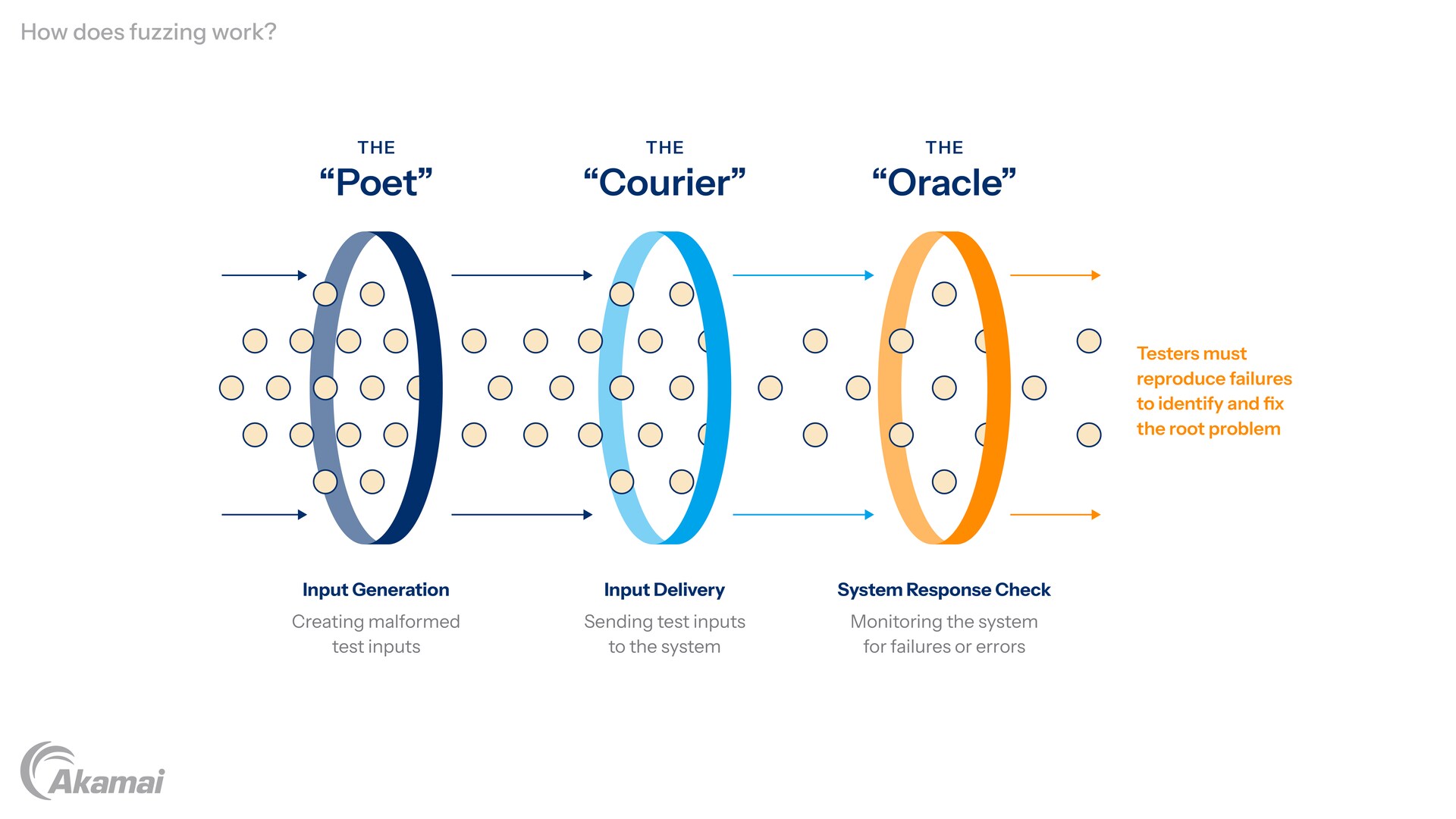
A fuzz testing solution has three elements:

  • The “poet” generates the malformed test inputs
  • The “courier” delivers the test cases
  • The “oracle” checks the target system to see if the fuzzing has caused a failure or other errors

This last process is important, because testers must be able to reproduce a failure using whatever random fuzzing variable caused it in the first place. If they can’t reproduce the error, they can’t fix the underlying problem.


Types of fuzzing

Two main types of fuzz testing predominate: behavioral and coverage-guided. A behavioral fuzz test is designed to show how an application is supposed to function. It tracks the differences between what is expected and what actually happens in the test. Coverage-guided fuzz testing looks at source code for apps at runtime. It probes the source code with random challenges, with the goal of discovering bugs.

Going a layer deeper, application fuzzing tests user interface (UI) features like input fields and buttons. The testing process might involve excessive demand, too-fast actions, or flooding fields with excessive amounts of text or numbers. Protocol fuzzing tests how a server reacts when a protocol introduces bad content. One goal here is to see if protocol requests will be misinterpreted as commands that will be executed on the server. File format fuzzing works with deliberately corrupted files, such as XML, JPG, or DOCX.

Fuzzing algorithms and techniques

Fuzz testing relies on specialized algorithms to generate random or malformed data for input. Algorithms are crafted to maximize code coverage, ensuring that each input variation can trigger unique paths in the application. Two common approaches in fuzzing algorithms are mutation-based fuzzing and generation-based fuzzing. Mutation-based fuzzing alters existing inputs to create variations, while generation-based fuzzing creates inputs from scratch, based on known structures or patterns.

Mutation fuzzing is often simpler and more suitable for black-box testing, where testers have no access to the application’s source code. Generation-based fuzzing is more complex and used for applications with known protocols, providing enhanced effectiveness in testing intricate logic. Both methods contribute to broader application security, uncovering issues that may go unnoticed with traditional testing approaches.

Benefits of fuzzing

Fuzzing offers QA teams a variety of benefits. For one thing, it’s simple, so fuzzing tends to be easy to scale and is cost effective. The overhead is low, in terms of both time and cost. Once a fuzzing test process is running, it works more or less on its own — without requiring much, if any, human action. It can keep going for an extended period of time.

Simple as it may be, however, fuzzing is often able to detect serious problems and bugs that other testing methods won’t pick up. It’s known for picking up zeroday exploits, for example. Fuzzing delivers a high-level picture of system quality. This is one of the reasons why fuzzing is a popular technique by both ethical and malicious hackers.

Challenges of fuzzing

Fuzzing has its limitations and challenges. For instance, fuzzing is not very effective at picking up the presence of silent threats that do not cause system crashes or errors. These include worms, Trojans, rootkits, and spyware. Users of open source fuzzers may find the toolset to be somewhat opaque. It can be difficult to know what’s actually happening. Reproducing results tends to be hard at that point.

Why API security testing is superior

Fuzzing is not ideal for testing application programming interfaces (APIs). While fuzzing can be useful for probing APIs for problematic responses, such as with overlong queries and code injection, it cannot test for some of the most serious API security weaknesses. For example, fuzzing is not able to determine if an API has been misconfigured, a major source of vulnerability. Nor can fuzzing help with API access control and user authentication.

Instead, proven API testing methodologies and tools are better able to inspect APIs and root out the OWASP Top 10 API vulnerabilities, which fuzzing cannot do. What’s more, API testing processes can reveal “rogue” APIs that operate outside of security controls, as well as “ghost APIs” that have been forgotten and can pose significant risk.

Fuzzing is an essential software and IT system testing method. It can do things that no other type of testing can accomplish. That said, fuzzing has its limitations. As previously mentioned, it is not well suited to “silent” threats or for testing APIs. API testing is better left to practices and toolsets that enable testing of API configurations and detection of known API vulnerabilities, as well as that assess API inventories and track access and authentication.

Frequently Asked Questions

Fuzzing plays a crucial role in software development by enhancing security and reliability. It involves subjecting a software system to unexpected, invalid, or random inputs to identify vulnerabilities early in the development lifecycle. By simulating real-world scenarios and unexpected user inputs, fuzzing helps detect and address potential weaknesses, such as API vulnerabilities, before malicious actors can exploit them. 

Incorporating API fuzz testing into the software development process promotes robustness and resilience, ultimately improving the overall security posture of applications. As a result, it’s an indispensable tool for ensuring the effectiveness of API security testing and mitigating potential risks.

Several popular fuzzing tools are widely used in software testing and security assessments. American fuzzy lop (AFL) is known for its effectiveness in finding vulnerabilities by generating mutations in input data. LibFuzzer, part of the LLVM compiler infrastructure, is renowned for its simplicity and integration with development workflows. 

Peach Fuzzer is notable for its robustness and support for multiple protocols and file formats. Radamsa is a versatile and lightweight tool for generating random inputs. These tools, among other API security testing tools, are essential for API fuzz testing and play a vital role in identifying and mitigating potential security flaws in software systems.

The future of fuzz testing in cybersecurity is promising, with emerging technologies such as AI and machine learning poised to revolutionize the field. These advancements enable fuzzing tools to evolve beyond traditional mutation-based approaches by intelligently generating test cases and adapting to complex software environments.

AI-driven fuzzing can enhance automation, scalability, and effectiveness in identifying vulnerabilities, especially in APIs and complex systems. As cyberthreats evolve, integrating AI and machine learning into fuzzing techniques will be essential for staying ahead of adversaries and ensuring robust security testing practices in software development and cybersecurity operations.

Setting up a fuzzing environment requires careful planning and execution. Select appropriate fuzzing tools tailored to your project’s needs and target applications. Next, establish a dedicated testing environment to isolate fuzzing activities from production systems. Configure the chosen tools to generate and execute fuzzing test cases against the target application, monitoring for crashes or unexpected behaviors.

Why customers choose Akamai

Akamai is the cybersecurity and cloud computing company that powers and protects business online. Our market-leading security solutions, superior threat intelligence, and global operations team provide defense in depth to safeguard enterprise data and applications everywhere. Akamai’s full-stack cloud computing solutions deliver performance and affordability on the world’s most distributed platform. Global enterprises trust Akamai to provide the industry-leading reliability, scale, and expertise they need to grow their business with confidence.

Related Blog Posts

AI Pulse: How AI Bots and Agents Will Shape 2026
Read our reflections on AI bot traffic across the Akamai network in 2025 and get our predictions for how these trends will shape agentic commerce in 2026.
Peak Season Isn’t a Season. It’s the World You Operate In.
Peak season isn’t seasonal anymore. Learn why modern surges stem from security risks, not traffic, and how Akamai keeps businesses resilient every day.
AI Pulse: How AI Bots Surface Your Content
Read about the different ways AI systems gather content — and learn why evasive scrapers, not just AI bots, continue to exert most of the pressure on media.

Explore all Akamai Security Solutions

Start your free trial and see what a difference having the world’s largest and most trusted cloud delivery platform can make.